

OUR INSIGHTS

The Workplace in 2026: Redefining Leadership and Expanding Economic Power
February 28, 2026
The workplace is not what it was even three years ago—and it will continue to evolve at an accelerated pace. As we move through 2026, organizations are navigating rapid technological change, shifting workforce expectations, and an urgent need to build more resilient, adaptable leadership pipelines.
At Women Business Collaborative, we believe the future of work will be defined by a simple but powerful question: Who is prepared to lead in complexity?
The answer may not be where companies have traditionally looked.
The New Workplace Reality
The workplace in 2026 is characterized by three defining shifts.
First, skills are becoming more important than titles. Organizations are increasingly focused on agility, problem-solving, and the ability to operate in uncertainty. Leadership is no longer about tenure—it is about the ability to make decisions, lead teams, and drive results in real time.
Second, career paths are no longer linear. Today’s workforce is moving across industries, roles, and sectors. Leaders must be able to translate their experience and apply it in new contexts.
Third, human-centered leadership is critical. In a world shaped by AI and automation, the most valuable skills are uniquely human—resilience, collaboration, communication, and strategic thinking.
These shifts demand a new approach to talent.
Expanding the Definition of Leadership
For too long, leadership pipelines have been narrow—drawing from the same schools, industries, and networks. As a result, companies are missing out on extraordinary talent that already exists.
Women athletes and women veterans represent two of the most powerful—and underutilized—leadership pipelines in the economy today.
These women have already demonstrated what the future of leadership requires:
- Resilience under pressure
- Team leadership and accountability
- Strategic decision-making in dynamic environments
- Discipline, execution, and performance
These are not theoretical skills. They are practiced daily—on the field, in competition, and in service.
The opportunity is not to train these women to become leaders.
They already are.
The opportunity is to translate their leadership into business and economic impact.
From Experience to Enterprise
At Women Business Collaborative, we are focused on bridging this gap.
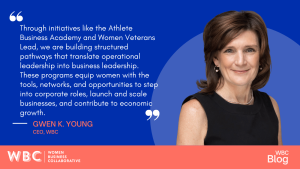
Through initiatives like the Athlete Business Academy and Women Veterans Lead, we are building structured pathways that translate operational leadership into business leadership. These programs equip women with the tools, networks, and opportunities to step into corporate roles, launch and scale businesses, and contribute to economic growth.
This is not just about career transitions. It is about unlocking leadership at scale.
When women athletes and veterans enter the workforce, they bring with them a mindset of performance, accountability, and teamwork that strengthens organizations. When they start businesses, they create jobs, drive innovation, and contribute to local and national economies.
The Business Case for Change
The data is clear: diverse leadership drives stronger performance, better decision-making, and increased innovation. Yet women remain underrepresented in leadership roles and underfunded as entrepreneurs.
At the same time, companies are struggling to find talent that can lead in today’s environment.
These are not separate challenges—they are the same opportunity.
By expanding leadership pipelines to include women athletes and veterans, companies can:
- Build stronger, more adaptable leadership teams
- Access proven, high-performing talent
- Strengthen their culture and employee engagement
- Drive business growth and innovation
And by supporting women-owned businesses, companies and investors can:
- Unlock new markets
- Build resilient supply chains
- Drive economic growth
A Call to Action
The workplace of 2026 requires us to think differently—not just about work, but about leadership itself.
We must move beyond traditional pathways and recognize the leadership that already exists across our communities.
At Women Business Collaborative, we are committed to building those pathways—connecting talent to opportunity, and ensuring that women are not only participating in the economy, but leading it.
The future of work is not just about technology or transformation.
It is about people—and the leaders who will shape what comes next.
Women athletes and veterans are ready.
The question is whether we are ready to invest in them.
Author
-

Gwen K. Young is the CEO of the Women Business Collaborative. She is also a Visiting Scholar at the Elliot School of International Affairs, George Washington University and former Director of the Global Women’s Leadership Initiative at the Wilson Center. She is an Advisor to Concordia. Ms. Young has worked across the globe to promote economic development, good governance and peace. She has developed strategy, programming and advocacy in the areas of humanitarian policy, international affairs and international development. This includes developing public private partnerships focused on public health, agriculture, gender equality, and access to finance. Further, Ms. Young has advocated for and published on international criminal law and designed SGBV guidelines. As an attorney, Ms. Young has worked as a professional advocate for women and human rights in corporate law settings, with the ICTY and the Kroc Institute for Peace and Justice at the University of San Diego. Her career has encompassed a comprehensive array of international organizations including the Bill & Melinda Gates Foundation, Medecins Sans Frontieres, International Rescue Committee, and the Harvard Institute for International Development. An alumna of Smith College, Harvard’s Kennedy School of Government and the University of California Davis, School of Law, Ms. Young has pursued a career of international public service focused on humanitarian relief, international development, and human rights starting with gender equality and equity.
View all posts