

OUR INSIGHTS

From Networks to Sponsors: Why Developmental Relationships Are Critical to Women’s Leadership Advancement
March 25, 2026
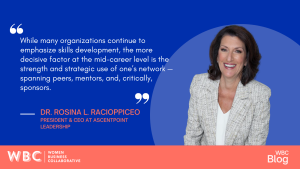
For women in business, advancement is rarely the result of performance alone. It is driven by visibility, advocacy, and access—outcomes accelerated through strong developmental relationships. While many organizations continue to emphasize skills development, the more decisive factor at the mid-career level is the strength and strategic use of one’s network—spanning peers, mentors, and, critically, sponsors.
Research and experience consistently show that relationship building becomes a defining differentiator as women transition from executing work to leading at scale. At this stage, success requires a shift from tactical excellence to strategic influence. Developmental relationships enable that shift by expanding perspective, increasing organizational awareness, and positioning women to be seen—and supported—as leaders.
Yet, despite the proven impact, many women still lack access to these relationships. In leadership programs, participants frequently report they have never had a mentor, and even fewer have experienced active sponsorship. This gap reflects not only limited access but also a lack of intentional approach. High-impact developmental relationships require clarity, consistency, and investment over time.
Beyond Mentoring: Building a Developmental Network
Mentoring is often viewed as a one-to-one relationship. In reality, the most effective leaders cultivate a broader network—a personal “board of directors”—comprised of individuals who offer different forms of guidance and support.
Mentors provide insight, feedback, and perspective, helping individuals navigate complexity. Sponsors play a distinct and critical role: they advocate. Sponsors use their influence to open doors, recommend talent for stretch opportunities, and actively support advancement.
Equally important are peer and cross-functional relationships, which enhance collaboration and deepen understanding of the business. Together, these connections form a developmental network that supports both performance and progression.
As one executive noted, “Don’t rely on one mentor. Be intentional about building many relationships that serve different purposes.” This reflects a shift from passive participation to strategic engagement.
The Strategic Mindset: A Leadership Imperative
At the core of effective relationship building is a strategic mindset. Women who derive the greatest value from mentoring and networking approach these interactions with clarity and purpose.
This begins with defining a “north star”—a clear understanding of career goals, strengths, and development priorities. Without this foundation, relationships can become unfocused or transactional. With it, they become a powerful mechanism for growth.
Preparation is equally critical. The most productive mentoring relationships involve individuals who come prepared, seek targeted feedback, and apply insights in real time. This discipline signals professionalism and maximizes the value of each interaction.
Common derailers include inconsistent engagement, pre-judging the value of a mentor, and failing to act on feedback. Avoiding these pitfalls requires accountability and a commitment to continuous learning.
What the Research Shows
My research, Mentoring Wisdom, examined how women cultivate and leverage mentoring relationships to support leadership development and career progression. A clear pattern emerged: women who approach these relationships with intention achieve stronger outcomes in both development and advancement.
Two practices consistently distinguished high-impact participants:
- Deliberate Preparation – High-performing women entered mentoring conversations with clarity on their goals, challenges, and organizational context. This enabled more focused and strategic dialogue.
- Structured Engagement Strategy – Rather than relying on informal interactions, they established a clear approach to engaging mentors, aligning conversations with specific priorities and using each interaction to increase learning and visibility.
The research reinforces that mentoring is most effective when treated as an active, evolving process. Women who manage these relationships with discipline and purpose are better positioned to translate insight into tangible career outcomes.
The Role of Organizations
While individual ownership is essential, organizations play a critical role in fostering environments where developmental relationships can thrive. Formal mentoring programs are a valuable starting point, but they are not sufficient on their own.
Organizations must create cultures that encourage connection, value diverse perspectives, and normalize sponsorship. This includes preparing both mentors and mentees for success, setting clear expectations, and ensuring that high-potential women have access to senior leaders who can advocate for them.
Equally important is the quality of feedback. Research shows that women often receive less direct and actionable feedback than their male counterparts, limiting their ability to grow into senior roles. Effective mentoring and sponsorship help close this gap by providing candid, constructive guidance.
Being Intentional: The Differentiator
Across decades of leadership development work, one principle stands out: intentionality is the cornerstone of successful developmental relationships. Women who take ownership—who plan, engage, and follow through—are far more likely to translate insight into impact.
This intentional approach extends beyond formal programs. Mentors exist all around us—leaders, peers, and colleagues who challenge thinking, offer perspective, and expand understanding. The key is recognizing and leveraging these opportunities.
Ultimately, investing in developmental relationships is not optional for women seeking to advance—it is essential. Strong networks provide the insight, access, and advocacy required to navigate complex organizations and lead effectively.
The path to leadership is not built alone. It is built through relationships that inform, challenge, and champion growth.
Author
-

As President and Chief Executive Officer of AscentPoint Leadership, Dr. Rosina Racioppi spearheads her organization’s initiatives to help Fortune 1000 companies cultivate the talent they need for ongoing growth and profitability. Under her leadership, AscentPoint Leadership successfully partners with organizations across a wide range of industries to develop their high-potential women and to build a pipeline of diverse and talented leaders. (Read more)
View all posts






 CLICK “LEARN MORE” TO REGISTER