

OUR INSIGHTS

How Gender-Responsive Procurement Secures Global Trade in an Uncertain World
June 26, 2026
In 2026, global trade is navigating one of the most volatile environments in recent history. Geopolitical tensions, shifting tariffs, climate-related disruptions, cyber threats, and ongoing labor shortages continue to challenge supply chains across every industry. For business leaders, resilience is no longer optional—it is a competitive advantage.
The question facing procurement leaders today is not whether disruption will occur, but whether their organizations are prepared to respond when it does.
One of the most effective yet underutilized strategies for strengthening supply chain resilience is gender-responsive procurement.
Procurement Has Become a Strategic Function
For decades, procurement was viewed primarily as a cost-control function. Today, it sits at the center of corporate growth, risk management, and business continuity.
Leading organizations recognize that resilient supply chains require more than efficiency. They require adaptability, innovation, and diversified networks capable of responding quickly to changing market conditions.
This is where supplier diversity—and specifically engagement with women-owned businesses—creates measurable value.
By intentionally expanding procurement opportunities to qualified women-owned suppliers, companies reduce dependency on concentrated supplier networks and create greater flexibility throughout their value chains.
In an era where a single disruption can halt production, delay delivery, or increase costs overnight, reducing single points of failure is a strategic imperative.
Why Gender-Responsive Procurement Matters
There is a strong business case for ensuring women-owned and women-led businesses have equitable access to sourcing opportunities, contracts, and supplier development programs.
Women-owned businesses represent one of the fastest-growing segments of the global economy. They bring specialized expertise, local market knowledge, innovation, and entrepreneurial agility that large organizations increasingly need.
Research consistently demonstrates that diverse supplier ecosystems generate stronger problem-solving capabilities, improved innovation, and greater responsiveness to market shifts.
When corporations intentionally cultivate relationships with women-owned suppliers, they gain access to broader networks, alternative sourcing channels, and fresh perspectives that strengthen overall supply chain performance.
Supply Chain Resilience Through Radical Partnership
The traditional supplier model often relies heavily on a limited number of established vendors. While efficient during stable periods, concentrated supplier networks can become significant vulnerabilities during times of disruption.
The future belongs to organizations that embrace what we call radical partnership—the deliberate creation of collaborative ecosystems that distribute risk, expand capacity, and increase responsiveness.
Women-owned businesses frequently operate with a high degree of agility and customer focus. Many have demonstrated remarkable resilience through economic downturns, pandemic disruptions, and shifting market conditions.
By integrating these businesses into procurement strategies, corporations create:
- More diversified supplier networks
- Greater sourcing flexibility
- Enhanced innovation pipelines
- Increased regional and local market access
- Stronger business continuity capabilities
- Reduced concentration risk
These are competitive advantages.
The Connection Between Inclusive Procurement and Global Trade
Global trade depends on interconnected networks of suppliers, manufacturers, logistics providers, and service partners. When those networks become overly concentrated, entire industries become vulnerable.
Gender-responsive procurement helps strengthen global trade by broadening participation across the economic ecosystem.
Every contract awarded to a qualified women-owned supplier expands economic opportunity, increases market capacity, and contributes to a more resilient commercial infrastructure.
As governments, investors, and multinational corporations increasingly prioritize supply chain transparency and sustainability, inclusive sourcing practices are becoming an important indicator of long-term business health.
Organizations that embrace supplier diversity today are positioning themselves to compete more effectively in tomorrow’s global marketplace.
Driving Revenue Through Supply Chain Innovation
At Women Business Collaborative (WBC), we believe that gender equity and business performance are mutually reinforcing.
Our work with corporate leaders, entrepreneurs, investors, and partner organizations demonstrates that advancing women in business is not solely a social objective—it is an economic growth strategy.
Through collaboration, knowledge sharing, and strategic partnerships, WBC helps organizations rethink how they build leadership pipelines, access innovation, and strengthen supply chains.
Gender-responsive procurement is one of the most powerful examples of this intersection.
When companies expand opportunities for women-owned businesses, they are not simply checking a box. They are building more resilient supply chains, creating stronger market ecosystems, and unlocking new pathways for growth.
Looking Ahead
The companies that thrive in the next decade will be those that recognize resilience as a strategic asset.
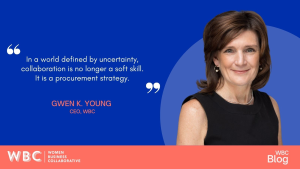
In a world defined by uncertainty, collaboration is no longer a soft skill. It is a procurement strategy. Inclusive sourcing is no longer a corporate responsibility initiative. It is a business imperative.
By investing in women-owned suppliers and embracing gender-responsive procurement, organizations can strengthen global trade, reduce risk, and position themselves for sustainable growth.
The future of resilient supply chains will be built through partnership, innovation, and inclusion—and women-owned businesses must be part of that future.
Women Business Collaborative is committed to advancing equal position, pay, and power for women in business while helping organizations unlock the economic benefits of inclusive leadership, supplier diversity, and collaborative growth.
Author
-

Gwen K. Young is the CEO of the Women Business Collaborative. She is also a Visiting Scholar at the Elliot School of International Affairs, George Washington University and former Director of the Global Women’s Leadership Initiative at the Wilson Center. She is an Advisor to Concordia. Ms. Young has worked across the globe to promote economic development, good governance and peace. She has developed strategy, programming and advocacy in the areas of humanitarian policy, international affairs and international development. This includes developing public private partnerships focused on public health, agriculture, gender equality, and access to finance. Further, Ms. Young has advocated for and published on international criminal law and designed SGBV guidelines. As an attorney, Ms. Young has worked as a professional advocate for women and human rights in corporate law settings, with the ICTY and the Kroc Institute for Peace and Justice at the University of San Diego. Her career has encompassed a comprehensive array of international organizations including the Bill & Melinda Gates Foundation, Medecins Sans Frontieres, International Rescue Committee, and the Harvard Institute for International Development. An alumna of Smith College, Harvard’s Kennedy School of Government and the University of California Davis, School of Law, Ms. Young has pursued a career of international public service focused on humanitarian relief, international development, and human rights starting with gender equality and equity.
View all posts